
If you’re after information about the E minor pentatonic scale and how to connect their positions – instead, click here.
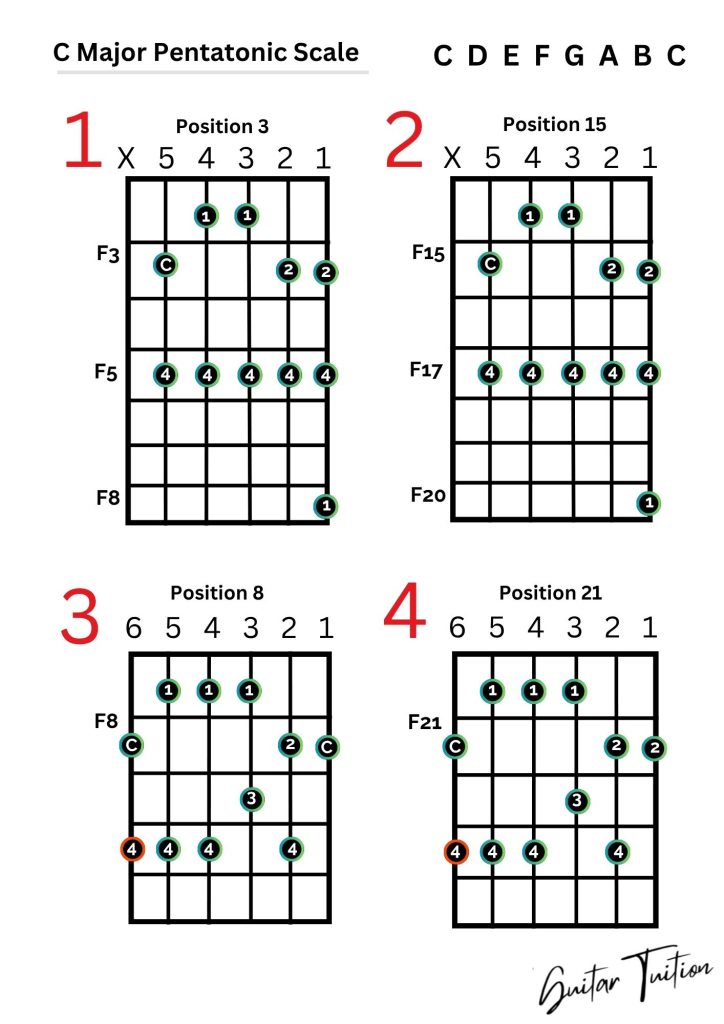
The C Major Pentatonic Scale
The major pentatonic scale is one of the most useful tools a guitarist can learn. As the name suggests, it’s built from just five notes taken from the full major scale. By leaving out the 4th and 7th degrees, you’re left with a scale that sounds open, musical, and very forgiving – even when you’re just starting to improvise.
In the key of C, the notes are:
C – D – E – G – A
That’s the root, 2nd, 3rd, 5th, and 6th degrees of the C major scale. No clashes, no awkward notes – just sounds that work.
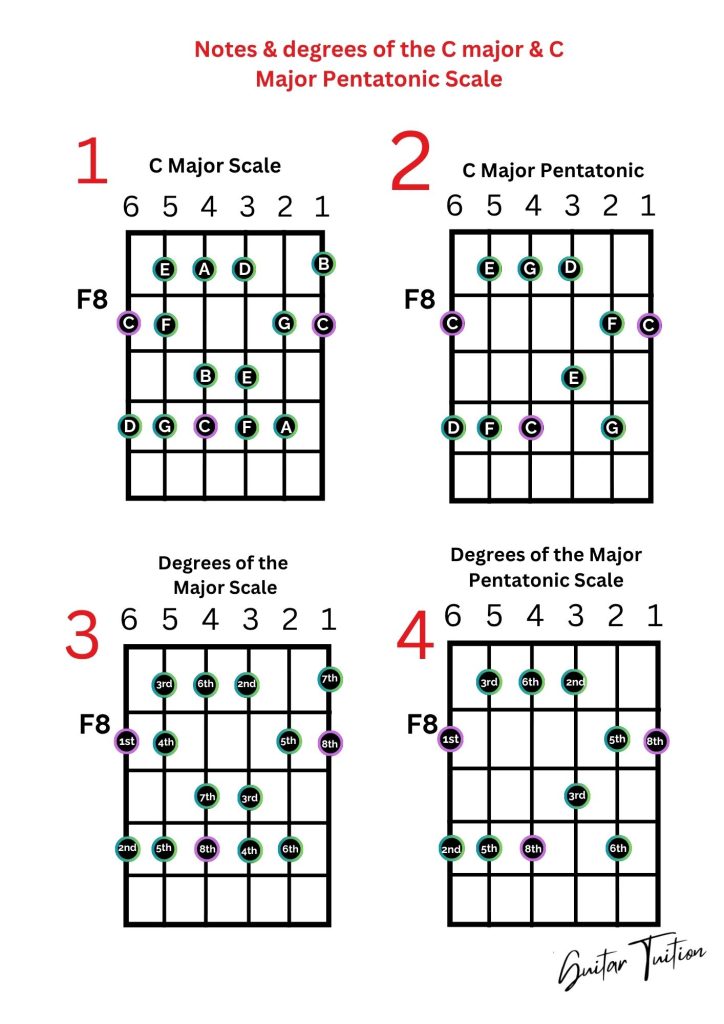
The notes of the C major pentatonic scale are:
- C (root)
- D (2nd)
- E (3rd)
- G (5th)
- A (6th)
Notice how the pentatonic scale skips the 4th (F) and 7th (B) notes of the C major scale, resulting in a more open, less tension-filled sound that fits well in genres like rock, blues, country, and pop.
Why Guitarists Love It
Easy to connect shapes – the scale is often taught in five patterns across the neck, so you can move freely up and down the fretboard.
Safe to use – without the 4th (F) and 7th (B), you avoid the dissonant notes that can sound harsh against chords.
Perfect for solos – whether you’re jamming over a C major progression or playing folk, pop, or blues, the scale always sits comfortably.
Where to Start
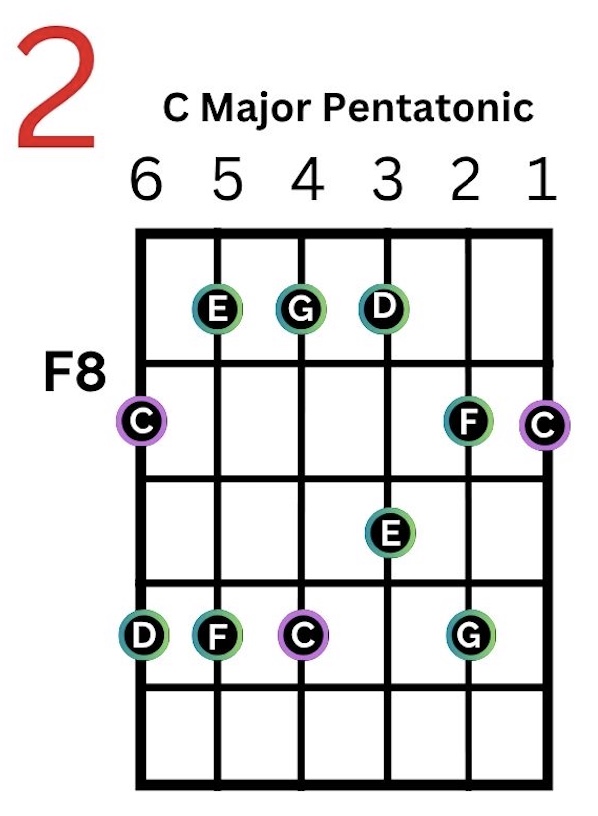
One of the most common positions begins on the 8th fret of the low E string (C). From there, you can play a two-octave version of the scale that fits neatly under your fingers.
You’ll also notice that these same five notes belong to the A minor pentatonic scale – the difference is simply which note feels like “home”. When you treat C as the root, it sounds bright and major; when you focus on A, it becomes minor and ‘bl’uesy’.’
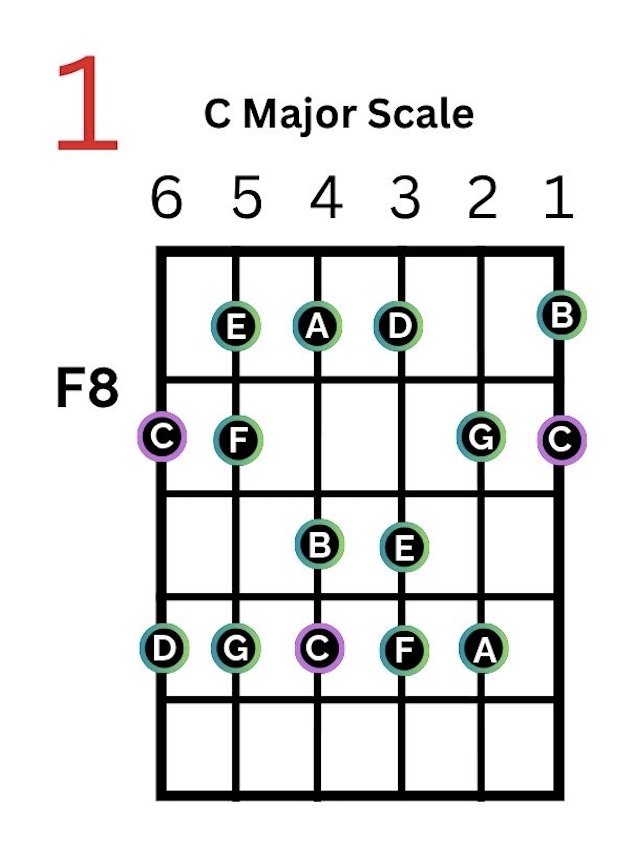
This is the C Major pentatonic scale in it’s simplest form without any open strings involved, starting on fret 8 – string 6. . Likewise with the Minor Pentatonic, you can play the C major pentatonic scale in different areas of the fretboard.
Converting notes of The Major Scale to Degrees of the Scale
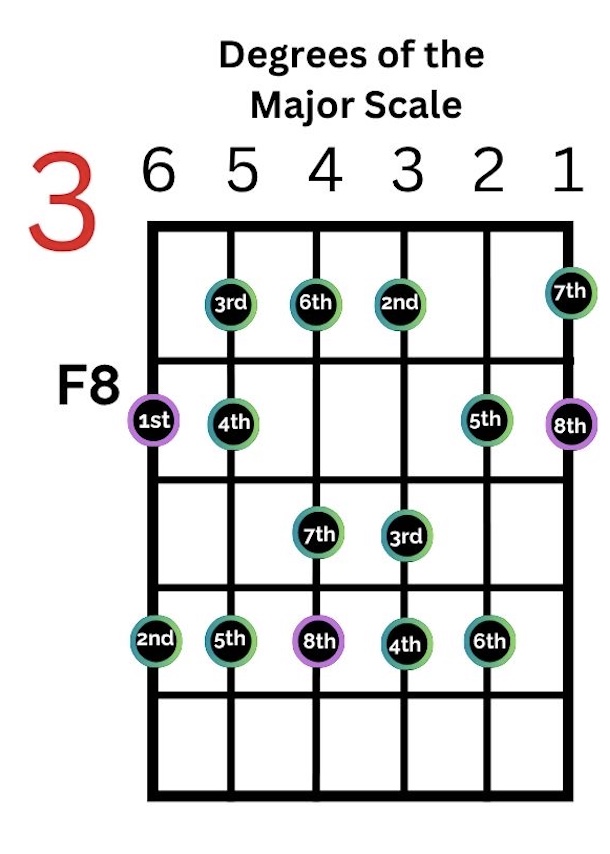
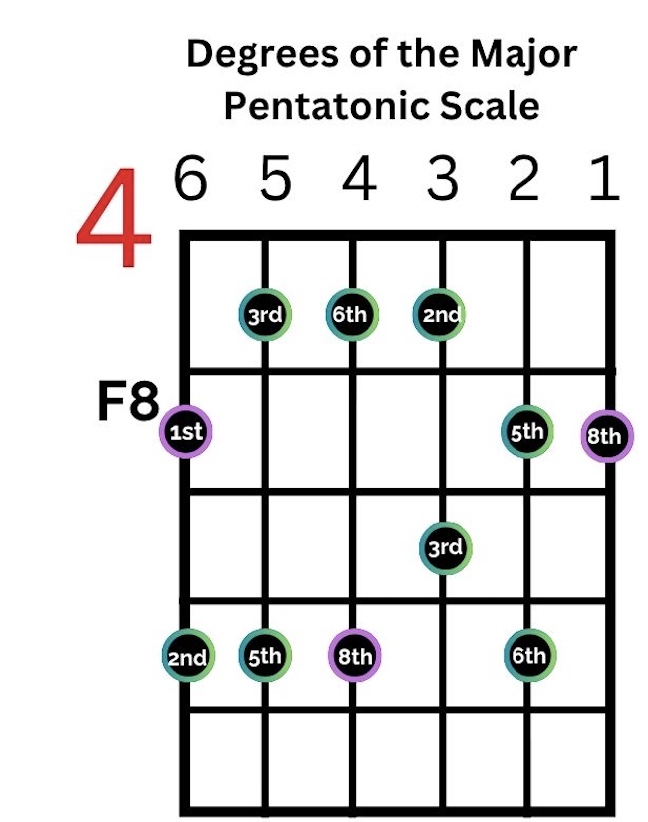
To Create the major pentatonic scale from the major scale we need the 1st, 2nd, 3rd, 5th, 6th and 8th degrees of the major scale or notes C D E F G & C.
Creating the Major Pentatonic Scale from the Major Scale
The Major Pentatonic scale is created from the Major Scale. The Pentatonic Scale has 5 notes per octave and the major scale has 8 notes per octave. We take the 1st, 2nd, 3rd, 5th & 6th degrees of major scale to create the major pentatonic scale.
Practicing tips with echo & economy picking
By removing the 4th and 7th degrees of the major scale, the pentatonic creates a more harmonious, uncluttered sound that is far less likely to clash with chords or melodies.
For soloing, it’s a guitarist’s go-to. Its stripped-back structure means you can play fast, flowing phrases without worrying too much about hitting dissonant notes. In the key of C, for instance, the C major pentatonic offers a safe, melodic framework for improvisation.
Practicing with Echo
You can set an echo delay pedal to a repetition of four at a tempo that doesn’t sound too messy – tyipcally 60-100bpm. The feedback option on the pedal adjusts the length. Once set you’ll be able to work with crotches for down strokes ascending / descending on the crotchet or quarter note and down & up strokes (economy picking) for quavers or 8th notes. Depending on which beat you play, you can harmonise using the major 2nd or major 3rd interval. You can also harmonise in perfect 4ths by playing on beats 1 & 4.
Changing the key
Changing key is straightforward: the same scale shape can be moved up or down the neck. You just start from a different root note. For example, if you shift the pattern so it begins on the 9th fret (C♯), you’ll be playing the C♯ major pentatonic.
Major Guitar Scales & purpose
Once you’re comfortable with the theory behind the major pentatonic scale and the major scale in the key of C, you can begin to understand how to connect the different positions of the same scale across the fretboard. You can also change chords to a minor chord using tonic notes from the A minor scale.
This will allow you to create ‘tonal colours’, without worrying about dissonance. Dissonance isn’t a bad thing, sometimes you want that to make a solo sound interesting.
Some thoughts:
- Melodic Soloing: Use the C major pentatonic scale to craft simple, melodic solos over chord progressions in the key of C. Because the pentatonic scale avoids the more dissonant notes, your solos will sound smooth and pleasant to the ear.
- Connecting Scales with Chords: Practice linking your scale patterns with the chords in the key of C. For example, you can use the C major pentatonic scale to solo over a C major chord, or even over a progression like C, F, and G.
- Improvisation: Once you’ve memorized the scale shapes, try improvising over backing tracks in the key of C. Focus on playing melodies that highlight the strong notes of the C major scale (C, E, and G), and experiment with using the D and A notes to add flavour. Think about how you transition from one note to the next you can use: hammer-ons, pull-offs, slides, long rhythms, staccato rhythms, legato etc.
C Major Scales & A Minor
I hope from reading this blog post you’ll have gained confidence in how to play the C Major Scale. The Good news is that you now know how to play the A minor scale too because they share zero sharps and zero flats for their key signature.
To be able to play the A minor scale, start on the note A and follow your alphabet.
This would be the same process if you wanted to play the B Minor Scale assuming you knew the positions for the scale of D Major. D Major and B Minor both share F Sharp and C Sharp or F# / C # for their key signatures.
Final Thoughts
Scales are useful for expanding the knowledge of the fretboard and thought process when improvising which in turn helps your dexterity. Finger dexterity is a combination of factors that result in being more efficient across the fretboard.
So, grab your guitar, start practicing, and soon you’ll see how these essential scales can transform your playing! If you have an delay pedal, try setting the tempo of the delay to 60 bpm, and have the delay last long enough to be able to play an interval of a 3rd apart. This is a nice way to make practicing those scales far more approachable.
Enjoy this article?
Why not give the facebook page a like?