I’d like to begin this blog post by introducing the intervals that make up any major chord from the corresponding major scale. If you already have some background in music theory, you may already be familiar with this.
Assuming your barre chord spans strings 6–1 and your root note is on string 6, the intervals (or scale degrees) of a major chord are as follows:
The Degrees of the C Major Chord
Major & minor scales have 8 notes per octave and each degree is associated with a different name too.
The first degree, is the Tonic, 2nd degree is the Supertonic, 3rd degree is the Mediant, 4th Degree is the Subdominant, 5th Degree is the Dominant, 6th Submediant, 7th Leading note, 8th Octave.
The degrees & note names of the C Major Scale or any major or minor scale have dedicated names to describe their placement from tonic to octave.
| Degree | Note name | Degree name |
|---|---|---|
| 1st | C | Tonic |
| 2nd | D | Supertonic |
| 3rd | E | Mediant |
| 4th | F | Subdominant |
| 5th | G | Dominant |
| 6th | A | Submediant |
| 7th | B | Leading note |
| 8th | C | Octave |
So you could describe the any Major chord with the root note starting from string 6 as using the: Tonic, Dominant, Octave Tonic, Mediant ,Dominant, Octave of the scale, but just the 1st, 5th and 8th compound 3rd, compound 5th 8th degrees will suffice.
We use the term compound to describe the fact that we’re using the interval beyond the first octave of the major or minor scale. This is also referred to as ‘Compound intervals’. Compound major 2nd would otherwise be known as the 9th degree.
This table explains: which note, which degree, the name of that degree (from the major scale), and which string the note is fretted on.
| Note name | Degree | Degree Name | String |
|---|---|---|---|
| C | 1st | Tonic | 6 |
| G | 5th | Dominant | 5 |
| C | 8th | Octave / Tonic | 4 |
| E | 3rd | Medient | 3 |
| G | 5th | Dominant | 2 |
| C | 8th | Octave | 1 |
How the C Major chord & Scale connects
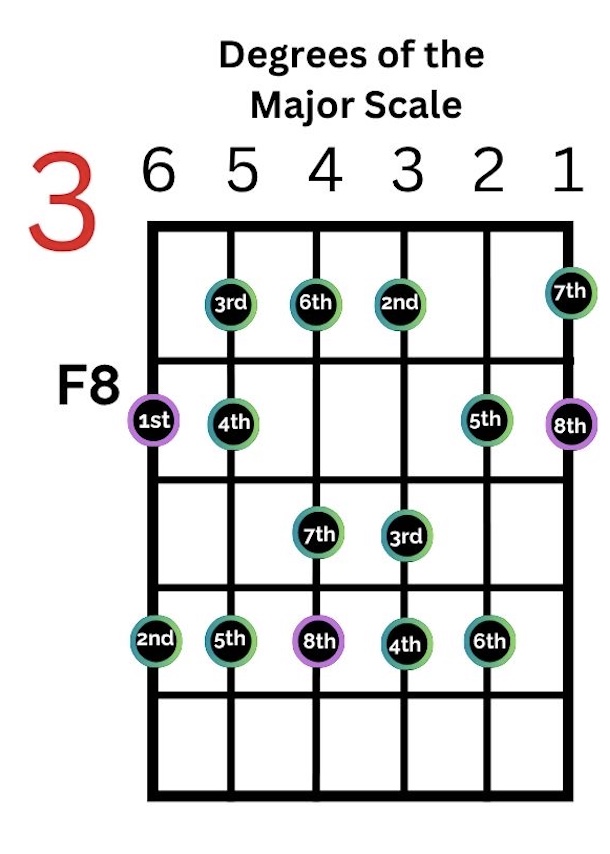
Here is a visual representation of the C Major scale starting on fret 8. You can create a major chord shape from any major scale position, but just to reiterate the principal, can you see that the notes of the C Major scale in barre form, are from the C Major scale:
The Foundation of Western Harmony for any major scale ( (T) T T S T T T S )
When describing the major scale we use the following formula: Tonic, Tone, Tone, Semi-tone,Tone, Tone Tone,Semi-tone.
This pattern helps us determine the correct sharps or flats in each key. In practical terms, especially for guitarists, this becomes even more useful: once you know the shape of one major scale position, you can move that same shape up one fret to play C♯ major, with the root landing at fret 9 (C♯). This makes it much easier to improvise in most major or minor keys.
So rather than thinking of the scale note by note, musicians tend to think in terms of shapes and intervals. This approach allows us to turn a “wrong” note into a “right” one by understanding how it functions within the scale.
Whole Steps and Half Steps in the C Major Scale
Just because there aren’t any sharps or flats in the C Major or A minor scale, doesn’t mean there aren’t any semi tones. E – F, B – C. These would be the two pairs of white keys next to each other on the piano.
Degrees of the A minor Scale using the C Major Position, Fret 8.
Because you now know how to play the C Major Scale, you could use the C Major Scale shape to play the A minor Scale starting from the note A. To play the second octave, the pattern will need to go beyond the shape of the current 2 octave C Major Scale starting from string 6 fret 8..
Notice how the 1st degree is now the note A and A is now the tonic played from string 4 fret 7, or using another pattern string 6 fret 5. The degree name remains the same, but the order of notes have of course, now changed.
| Note name | Degree | Degree name | String |
|---|---|---|---|
| A | 1st | Tonic | 4 |
| B | 2nd | Super Tonic | 3 |
| C | 3rd | Mediant | 3 |
| D | 4th | Sub Dominant | 3 |
| E | 5th | Dominant | 2 |
| F | 6th | Sub Mediant | 2 |
| G | 7th | Leading Note | 2 |
| A | 8th / 1st | Tonic / 8ve | 1 |
Modes
Degrees of the scale also have another application: guitar modes.
Modes refer to which degree of a scale you start on. You begin and end on that same note degree while still following the original scale’s pattern of notes.
For example, Ionian is the standard major scale. If you use the notes of the C major scale but start and finish on D instead of C, you are playing the Dorian mode.
To remember the names of each mode for each degree learn this nemonic:
I Don’t Particularly Like Modes A Lot
| Mode name | Degree | Degree name | Starting & finishing note |
|---|---|---|---|
| Ionian | 1st | Tonic | C |
| Dorian | 2nd | Supertonic | D |
| Phygian | 3rd | Mediant | E |
| Lydian | 4th | Submediant | F |
| Mixolydian | 5th | Dominant | G |
| Aolian | 6th | Sub Mediant | A |
| Locrian | 7th | Leading note | B |
| Octave |
Identifying Chord progressions from the scales & chords’ intervals
It’s not a major focus of this post, but it’s worth noting that once you become familiar with the sound of different intervals, you can begin working out chords by ear through interval recognition.
You’re already hearing this on the guitar, whether you realise it or not. Standard guitar tuning is mostly based on perfect 4ths when moving from string 6 upward, with the exception of the interval between string 4 and string 3, which is a major 3rd. Hence why you move to fret 4 – should you be tuning the old fashioned way!
Practicing tips:
Using a metronome, you can set the echo delay to a comfortable crotchet tempo and practise harmonising with yourself by delaying the interval and matching the exact number of beats.
Online offline – 1:1 tuition
If you would like to book an introductory no matter where you are in the world you can get in touch here.